Home

Woodland management with YWT…

Yesterday I met up with Peter, Sarah and the rest of their team from the Yorkshire Wildlife Trust. In a way it was a bitter sweet day in that Peter had noticed that one of the Wych Elm at Raw Nook NR had Dutch elm disease which is caused by the fungus Ophiostoma novo-ulmi which is spread by the elm bark beetle. Sadly because the disease kills the tree it had to be taken down.

So the 32 year old Wych Elm fell to the ground. However, the wood was cut up but not wasted as Sarah and Gillian got their creative heads on making various things.

The dark ring is the fungal bodies clogging up the
tree’s transport tissues, which will eventually kill the tree

The remaining wood has been left to nature and the invertebrates. Peter had also brought two new Elms to plant on the reserve another Wych and a Field Elm Ulmus minor which we do not have on site. And yes ! I will be recorded that as a new species for the reserve..ha

Replanting one of the new Elm trees

So once the Elm tree was sorted out it was on to other jobs. Which included taking a couple of Silver birch tree out to let more light onto the woodland floor.

The cut down trees have been left where they fell which will provide valuable habitats for various wildlife and insects.

Tackling the invasive Bramble

We also took out a good number of young Silver Birch sapling from the heathland area to help protect from encroachment.

Whilst Bramble is excellent for wildlife in can soon get out of hand especially in the heathland. So there was an excellent job in methodically cutting back the Bramble.

So all in all it was a very good day made even better for us all when in the afternoon a flock of 102 calling Pink-footed geese came in from the E and moved low to the S/W.

A big thank you to Sarah, Peter and volunteers from the YWT for all your hard work and time.

The Firethorn shrub…

Every wildlife garden should have one!. What I hear you ask? The beautiful Firethorn/Pyracantha shrub. Why?

Well there’s the lovely white flowers in spring that attract many bees and hoverfly species and then bright red berries feed hungry birds in the winter time. Oh! and you may get a surprise visitor like I did in my garden on Saturday…

A Blackcap which maybe over-wintering

Three at once…

Yesterday the skies were sunny and bright for me metaphorically speaking. After my shortened vis-mig watch as autumn migration is almost over I decided to go to Raw Nook Nr & TH Beck as I was on a mission to find a particular new moth leaf mine Ectoedemia intimella . The larvae mine the leaves of sallow (Salix), and Goat Willow

I thought I would have a look at the Goat Willows at TH Beck first.

After much searching I had drawn a blank.

However, I veered off one of the path into some fairly dense woodland and to my surprise I found a sapling Horse Chestnut tree. I scratched my head and thought I’m sure I have not recorded the species before in our area! I was right the sapling has been hiding in it’s dense surroundings!

So a new species and it was off to Raw Nook NR to find my moth. And yes I found the leaf mine Ectoedemia intimella so another new species. Incidentally Yorkshie Moths describe it’s status as: Local Status: Uncommon and local resident.

Stigmella salicis larvae

But then on a nearby Sallow Sp I found a different looking leaf mine.

And brilliant it turned out to be a leaf mine of Stigmella salicis…And my third new species of the day.

Because the leaf mines contain larvae the moth should emerge in spring. This proves the species are breeding in our area which is excellent news.

A bit of a rarity…

Vis-mig today was OK with the highlight been two large flocks of continental Starling that came in from the N/E. One party was estimated to contain 450 birds and all flying fairly low…an excellent autumn sight!

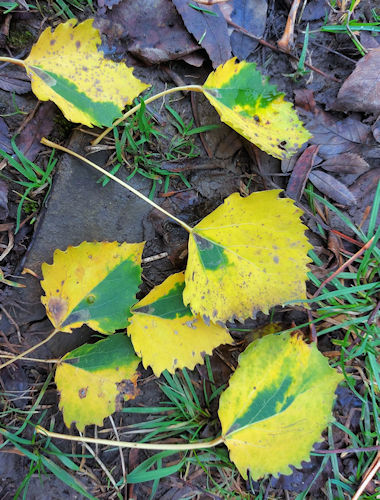
Recently I have been searching Aspen trees in Raw Nook Nr to try to find the moth leaf mine of Ectoedemia argyropeza with no luck. So I tried again today looking at Aspen leaves at the vis-mig point at Caldene fields.

There were none at the first two trees but further on to my excitement I didn’t find one leaf containing the moth larvae but 15!

If you look at the base of the yellow leaf you can see the dark triangle and the green above. The larvae are active mainly at night and retreat into the petiole (stalk) during the day.

The great news is that the moth is a bit of a rarity! National Status: Local. Local Status: Rare and local resident.

and according to Yorkshire moth the nearest site to ours is 20k away! So really pleased! That brings my moth species list for our recording area to 366.

Pond flashes Blue…

Yesterday there was little vis-mig due to the blanket fog. The little bit I did produced 3 skeins of Pink-footed geese moving N/W I could hear them but couldn’t see them in the fog.

I then walked to Raw Nook NR where the recent rain has brought our pond back to life. And the first bird I saw was a lovely Kingfisher feeding!.

Today I walked to TH Beck and heard the Kingfisher calling at the small pond, so keep your eyes peeled for that lovely flash of blue!

On my way back I couldn’t help but noticed the aptly named Jelly Ear Fungus – Auricularia auricula-judae on a dead piece of Elder.

Interestingly you can see the dead black Jelly Ear fungus below with a burst of new growth above.

Four Bullfinches were showing well in a nearby Hawthorn tree.

Record Smashed…

Wow! what a day at the vis-mig point. Wood Pigeon were on the move again and the conditions were just right cold with good visibility up to 20 miles.

It was an unprecedented morning !!! With my previous WP record totally smashed. The birds moved before dawn with one four figure count the highlight. Around 8am I had strings of 4,500, 2,400 and 4,560. Most birds observed moving to the E of the watch point. However, the count is probably an undercount as a casual glance over my shoulder and a ” Black cloud ” of pigeon passed high to the W. Passage stopped at around 09.00 then picked up again around 09.10 petering out around 10.00.

Total count 40,137

A well earn cup of tea after a hectic morning!

Wood Pigeons on the move…

Wood Pigeons have been moving S over and to the E of the watch point for the last few days. I must admit I was surprised that the birds would start to move with a strong headwind…but they did.

On the 31/10 I recorded 2,497, a 1,007 on the 1/11 and 7,598 today Please see: https://www.trektellen.org/count/view/779/20201102

Normally Wood Pigeons seem to favour the cold frosty mornings in autumn with little wind to move S. However, the birds have started to move in unfavorable weather conditions i.e. mild weather and a strong headwind. The weather is to settle and turns cooler in the next few day so it will be interesting to noted what happens then.

New fungus nearly gets away…

Following on from our Fungus foray on the 20/10/20 Peter Gurney YWT who attended the foray found another photo of a fungus Spinellus fusiger Bonnet Mould which was not added to the original list!

And even better it’s a new Fungi species of our list! Well Peter..and an excellent photo too..

FROM ”first-nature.com” This very common little parasite of Mycena species (and of several other mushroom genera) is known as a pin mould. It appears on the caps of larger fungi as erect pale brownish-yellow sporangiophores (specialised hyphae) on which its zygospores are produced.

Bonnet Mould and the other members of the Spinellus genus are able to reproduce when ‘pins’ from the same mycelium contact one another; such fungi are termed ‘homothalic’. FROM ”first-nature.com/

Fungus Foray…

On the 20th of October I attended a Fungus foray at Raw Nook NR lead by the very knowledgeable Kat Woolley of the Yorkshire Wildlife Trust. This follows on from last years successful fungus survey by Kat on the 22/10/19.

Sadly due to Covid 19 restriction only 6 people could attend and social distancing was in place. The main aim of the meeting was to build a better understanding of the species that inhabit the reserve and to increase the species list which stood at 48 species, so there was no pressure of Kat..ha..ha

Kat…quickly finds some interesting fungi

We first headed for the dense Hazel and Willow scrub area in the middle of the meadow.

It was suppose to be a quick look but we kept Kat that busy with the interesting finds….we were in there a good hour!

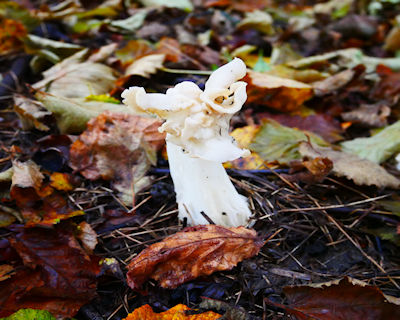
White Saddle Helvella crispa

One of the more strange looking fungi found in this area is the White Saddle Helvella crispa which was also found last year in the same location.

Also found was the delightfully name Lemon Disco – Bisporella citrina fungi…

Incidentally Sarah Goldsmith YWT who also attended has brought out an excellent ” Virtual fungus foray” https://www.facebook.com/groups/BUD.Bradford/ with a map…So you too can find and enjoy the Fungus Foray!

Walking on to the flooded area on the left we found hardly any fungi however, Kat pointed out on a nearby Willow a lovely Blushing Bracket Daedaleopsis confragosa. One of my favorite members of the Bracket family.

Blushing Bracket (Underside)

It was soon time for a well earned rest….Well for Kat anyway… so it was a quick stop for lunch.

As we continued more and more new species were found including the Leaf Parachute Marasmius epiphyllus, Common Rustgill  Gymnopilus penetrans and the worryingly name Poisonpie Hebeloma crustuliniforme.

Heath Waxcap Gliophorus laetus

We eventually arrived at the top of the reserve by the large heather patch ( Near the bridge. ) It wasn’t long before Kat let out a ” Oh! brilliant ” as she had identifield not one Waxcap fungi species but three! Which is excellent news for this urban reserve.

The three species were the Heath, Meadow and Vermilion waxcap.

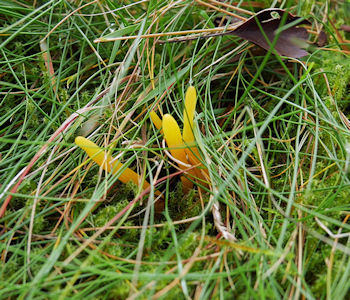
Yellow Club – Clavulinopsis helvola

Another new species found just by the Waxcaps was the lovely Yellow Club – Clavulinopsis helvola

So as we came to the end of the foray it was time to total up Kat’s finds. An excellent 18 new species were added to our list of 48 fungi species for the reserve.

However, there was one species that summed up the fungi walk for me, the privilege to witness the birth of an emerging fungi.

An emerging  Fly agaric Amanita muscaria about to burst into life

Special thanks to Sarah Goldsmith for arranging the foray and an even bigger thank you to Kat Woolley for all her patience and knowledge.

error: Content is protected !!