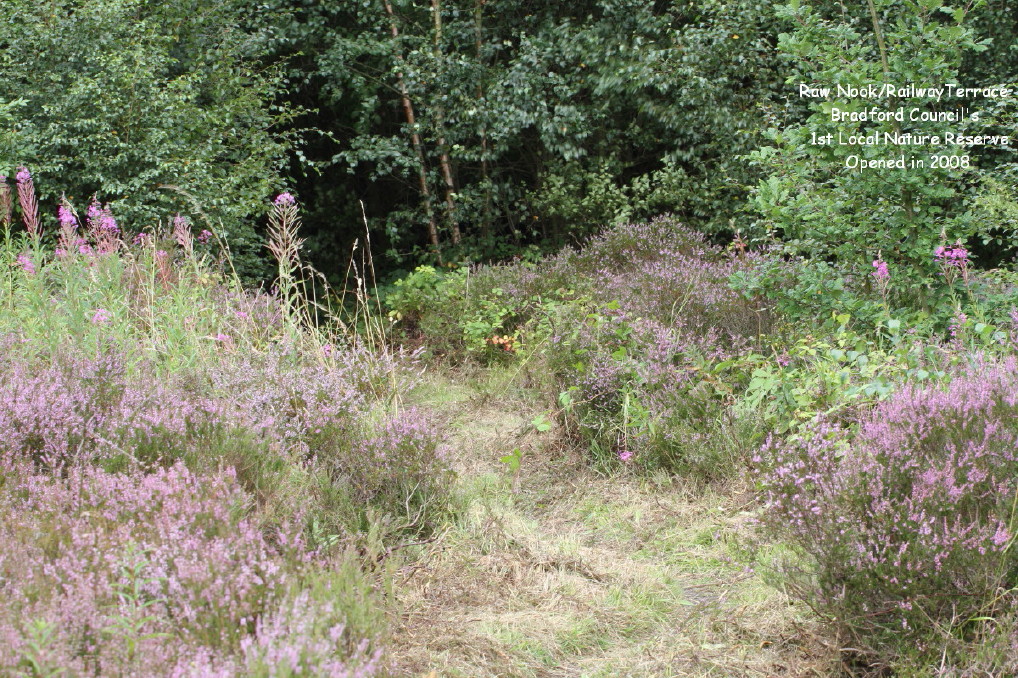
On Saturday morning it was our conservation groups work day. The outside temperature was -2c and the ground was covered in a light dusting of snow.
And I have to admit I did think ‘ Our we Mad?’
However, the plan was to dig up this years small Silver Birch saplings at Raw Nook NR that are a constant threat to our rare (In urban areas) lowland heath habitat.
We do the work now when the saplings are small, because when they are larger…Well..It’s back breaking work!!. Also if we left the saplings to grow this area would revert to birch woodland and our jewel would be gone forever.
With the mattock the small sapling came up fairly easy. We must have dug up at least 100 saplings but there is still many more to dig up which is a job for next month…weather permitting! If you want to help save this jewel, why not come along? More info from drahcirbiz@live.co.uk
Regular visitors to Toad Holes Beck will have noticed the excellent new steps and board walk which leads to the middle pond. This area whilst good for the Southern Marsh orchids is always muddy and difficult to walk along.
A member of our conservation group the very talented Michael Wiggins carried out the work and just like magic sorted the problem out..Excellent job Michael.
On Saturday we had our workday and as well as admiring Michael’s work we started to clear the vegetation near to the pond area.
This will let more light into the area and all the branches and twigs cut will help create better nesting opportunities.
Clearing vegetation from the pond and path area.
One of the new generation of conservationist who WANTED to litter pick the area.
But in a way I felt rather sad that she/we have to do this litter picking when some people sadly don’t respect our wonderful wildlife oasis!
During the last few weeks I have been asked about an unidentified large bird of prey (Raptor) that has been seen in the Low Moor area. I saw the bird (A female Sparrow Hawk) about a week ago at distance whilst doing my vig-mig ( visible migration).
Now female Sparrow Hawks are larger than the males but I have to admit she is very large and possibly one of the biggest I have seen.
Thankfully though the other day she appeared over the watch point and flew directly overhead which sent panic amongst the local bird community, but give me a good photo opportunity.
The Twite Linaria flavirostris is a fairly common bird found in moorland habitats in the north of England and Scotland. However, in autumn some birds including continental birds, move to the coast of eastern England for the winter where they can be found on saltmarshes and coastal fields.
However, some years I pick up a few of these uncommon finches (To lowland Bradford) as they move over the watch point. My best count was of 5 calling birds on the 29/10/2009.
However, today was special!. A party of 27 Twite came in from the north overhead and swirled down to the fields to land! Sadley they were spooked, and gained height and moved off to the south.
Has we are aware the water in our wildlife pond at Raw Nook NR drains away unless there is content rain.
Funding was secured and a company was employed to fix the problem in the summer. Unfortunately, this did not happen, and the work was scheduled for the last week in October just as we had very heavy rain. Therefore the rain water had to be drained before work could commence.
A decision was taken to reschedule the work for the spring/summer period 2023 when the pond will be dry.
My concerns are that if the company let us down this summer…will it happen again ? However, I am determined that our wildlife pond will be repaired as promised…. ‘ Like a dog with a bone ‘ springs to mind!
On a different note it was a real shame I had to speak at the Oakenshaw Residents meeting last week regrading the on going problem of Dog Fouling at Raw Nook NR and TH Beck.
Thankfully the Council has now put up signage at the sites which is great news and the Wardens have and will patrol the areas.
Hopefully the irresponsible dog walkers will start to pick up their dog’s poo and take it home rather than polluting OUR nature reserves.
The last few days have been busy at the watch point with the annual dispersal of Wood Pigeon to the south.
The dispersal starts around the last week in October and lasts into early November.
Whilst huge numbers move south the reason why they do this at this time of the years, well, is still not fully understood.
However, the Bradford area is well situated to view this event and Low Moor along with Oxenhope gets some excellent counts of birds. At the watch point many birds move directly overhead but the majority are observed moving mainly to the east of Low moor.
Our good friend Peter Gurney YWT has certainly left a lasting legacy at Low Moor Banks. Firstly, it was his suggestion to give the name Low Moor Bank to the site, which was always referred to as ‘ The old tip site’. However, he has now installed a lovely new information notice board for the site.
In spring and summer, I would certainly recommend a visit to the site which is located on Dealburn Road, Low Moor Bradford BD12 0RG.
I keep wildlife records for the site however, I cannot get up there as often as I like as I am kept busy at Raw Nook NR & Toad Holes Beck. However, I have found some interesting finds like breeding Lesser Whitethroat, Six-belted Clearwing + Blackneck moths, breeding Small Heath butterflies and several species of Orchids. So if you do visit would you kindly pass any records on to me, please as sadly like a lot of places in south Bradford development is always a worry.
Just to finish I have been busy with vis-mig ( watching visible bird migration ) during the last few weeks with thrushes coming into the UK from Scandinavia and Wood Pigeon on their annual movement south. Here are a few special sightings viewed from the watch point:
19/10: 4,017 Fieldfare moving S + 906 Starling moving S/W
On Tuesday the 18th of October it was our annual Fungi Walk at Raw Nook NR with our friends at YWT Sarah, Peter with Kat Woolley (YWT fungi expert) leading the walk. However, we had another guest expert joining us, Ian Forward from the Mid Yorkshire fungus Group..so basically a Dream Team!
The weather prior to the walk had been good for fungi so hearts were beating…
I explained to the group that our site list stood at 84 species of fungi so if the experts could find a further 16 new species that would be fantastic for our urban site.
Verdigris Agaric
Almost straight away in the meadow Verdigris Agaric – Stropharia aeruginosa was found which was a site first.
Further along excitement grow further when a Saffron Milkcap – Lactarius deliciosus (Below) was discovered.
In actual fact the meadow produced an array of fungi attributed to the excellent meadow maintenance work done by Peter from YWT according to Ian ( Fungi expert)
Saffron Milkcap
Moving on from the meadow we entered the wooded area of the reserve.
As well as learning as much as I could from the experts I was ‘Trying’ to keep a list of all the finds and it wasn’t long before there were squeals of excitement as new species like Clustered Domecap – Lyophyllum decastes, Elfin Saddle – Helvella lacunosa and the tiny but lovely Orange Bonnet Mycena acicula were found.
Bird’s nest fungus (Photo by Peter Gurney)
However, as the species list grow, there was a special moment that will last a long time not only in my mind but the excited experts as well.
Hawkeye ‘Jess’ suddenly let out a loud gasp which had us all scurrying to her location.
She had found the find of the day a Bird’s nest fungus Crucibulum leave by the fence near the railway line.
The walk started at 10.00 and should have finished around 13.00. Smiling faces were leaving at 15.00! But for me it was home to input the finds. And I got a surprise with 53 species identified of which 22 were new species which brings the total for our reserve to 106 species.
Despite these excellent figures to have expert mycologists like Kat and Ian say comments like’ What an excellent site this is ‘ Well for our group…that’s the icing on the cake!
Many thanks to Kat Wooley, Ian Forward and ‘Hawkeye’ Jess for a brilliant day and helping to add 22 new species to our fungi list
This website uses cookies to improve your experience. We'll assume you're ok with this, but you can opt-out if you wish.AcceptRead More
Privacy & Cookies Policy
Privacy Overview
This website uses cookies to improve your experience while you navigate through the website. Out of these, the cookies that are categorized as necessary are stored on your browser as they are essential for the working of basic functionalities of the website. We also use third-party cookies that help us analyze and understand how you use this website. These cookies will be stored in your browser only with your consent. You also have the option to opt-out of these cookies. But opting out of some of these cookies may affect your browsing experience.
Necessary cookies are absolutely essential for the website to function properly. This category only includes cookies that ensures basic functionalities and security features of the website. These cookies do not store any personal information.
Any cookies that may not be particularly necessary for the website to function and is used specifically to collect user personal data via analytics, ads, other embedded contents are termed as non-necessary cookies. It is mandatory to procure user consent prior to running these cookies on your website.