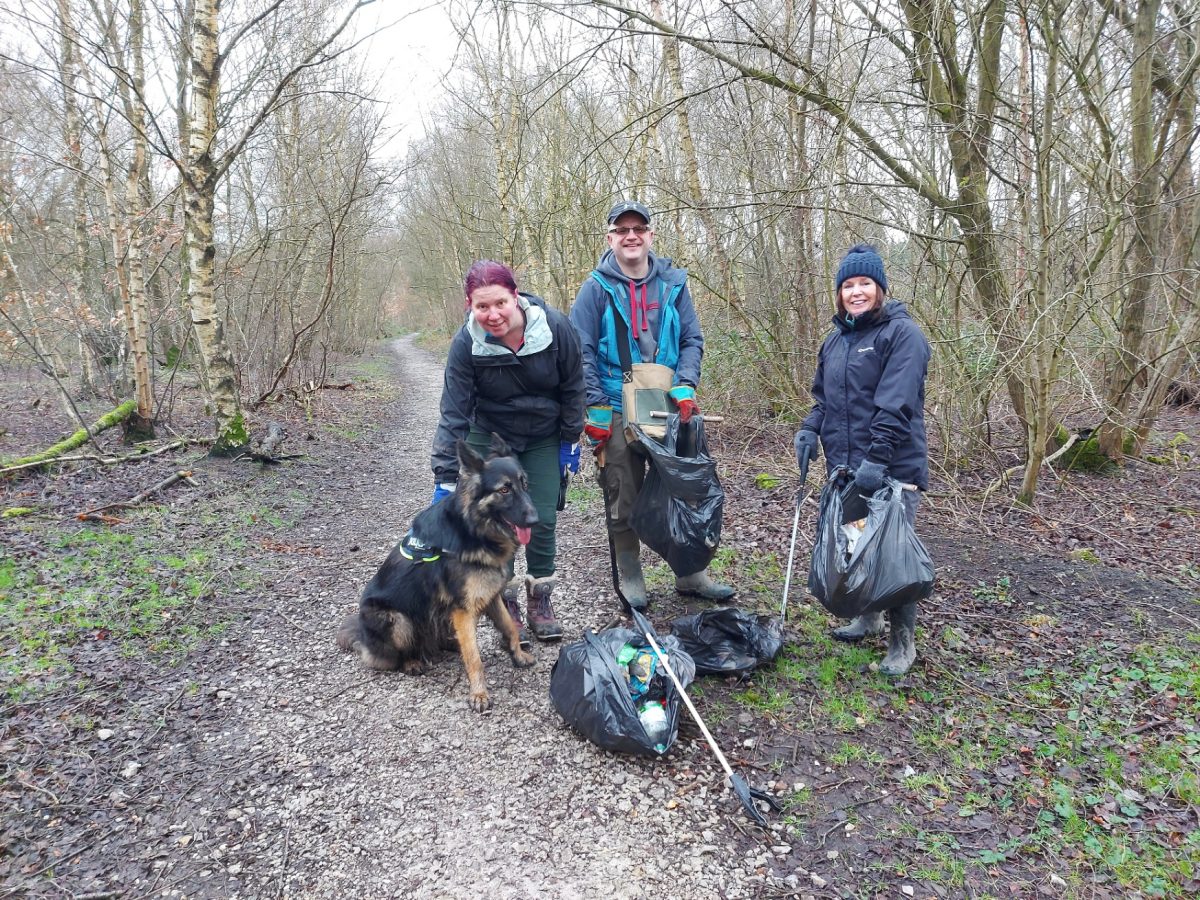
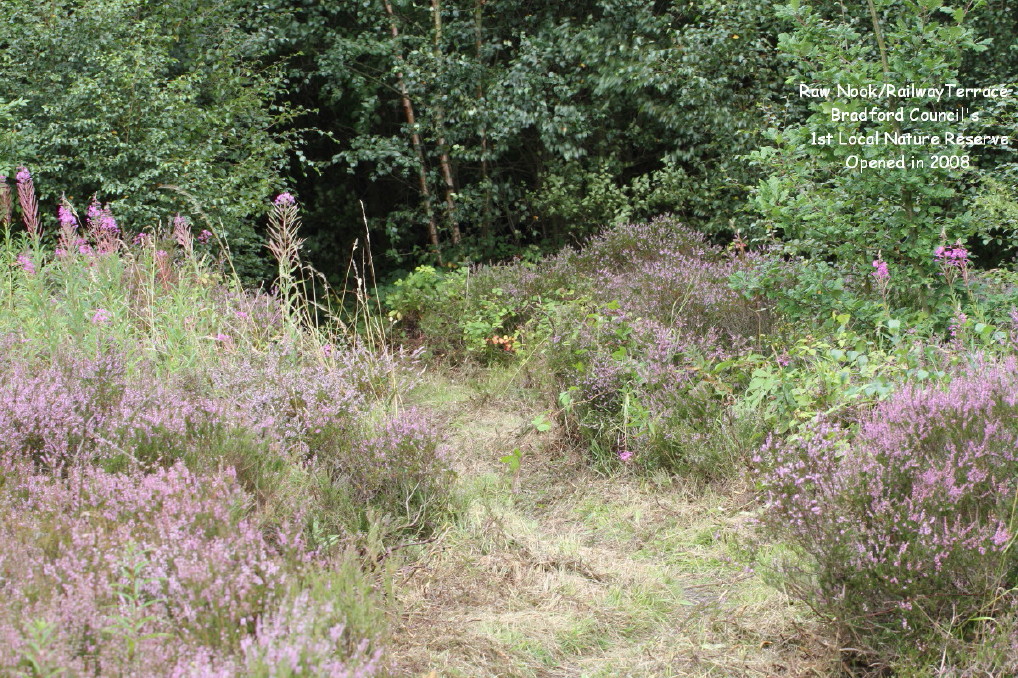
Yesterday members of the Low Moor/Oakenshaw conservation group had a litter picking morning at Raw Nook NR.
We picked up about 6 bags of rubbish mainly discarded cans crisp packets and bottles.
Clare brought down her lovely new German Sheppard dog…to help.
Now Clare is ‘ An excellent ‘ dog owner picking up her dogs poo, bagging it and putting in a bin!
However, one thing sadden all the group!
Irresponsible dog owners!!!! we found and picked up black poo bags that had simply just been thrown into nearby trees.
Also Clare sent a lot of her time picking up other dogs poo left by Irresponsible dog owners!!!!
PLEASE THINK ABOUT YOUR ENVIROMENT!
On a better note…Scarlet Elf cups (fungi) appear to be everywhere at the moment even growing near the entrance to the reserve, something I have not seen before.
There is a flock of at least 31 Siskin feeding in Alder trees around the small pond at Toad Holes Beck. Their numbers are increasing as I counted just 16 on the 21/1. Given the mild weather and a bit of sunshine this morning a number of males were in full song.
There must be a good crop of Alder seeds this year and this bounty may attract some Lesser Redpolls in the coming days and weeks.
This week I have been busy collating my 2021 wildlife records.
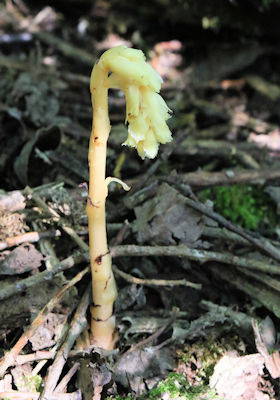
Yellow Bird’s-nest – Hypopitys monotropa
I have submitted a respectable 1,121 records for 2021 to the Yorkshire county recorders and West Yorkshire Ecology Service (WYES).
It is in my opinion imperative that bodies like West Yorkshire Ecology Service are kept fully up dated with accurate wildlife records for our wonderful urban wildlife haven. Should anything happen in the future.
The key feature of the (WYES) is to provide informed and authoritative advice and information to the planning authorities in West Yorkshire to help conserve the most significant biodiversity habitats and species.
What has been nice this year is the amount of records I have received for the reserve and local areas.
So I would like to take this opportunity to thank all those people who have sent me records this year.
Leah Poppy who found the Yellow Bird’s nest at Raw Nook described by some as nationally scare.
Geoff and Sue Dunn for their plant records. The Bradford Botany Group for their excellent plant survey at Low Moor Banks.
Julie, at B.B.E for their records . Kat Woolly from YWT for all her fungi records and to all at the YWT for their help and support and anyone else I have missed.
In amongst those records are some pleasing additions to my species lists as well as new breeding records. Those include establishing that the Tree Creeper is now breeding at Toad holes Beck and the finding of two uncommon Lunar Hornet moths at Raw Nook Nr with the possibility that the species may be breeding there.
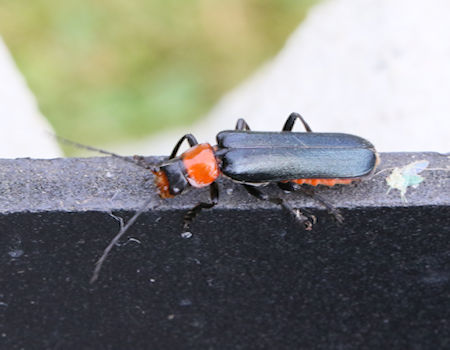
However, for me the highlight came on the 14/6/21 when I found this beetle opposite in the moth trap at Caldene fields.
Given the beetle has many cousins! it was finally ID by Mr M Geiser of the Nation History museum!
Then followed a debate about the finer ID points of the beetle with other knowledge entomologist in northern Europe!
So a bit of fame for our urban oasis!
So what will be found this year? Well if you do find an interesting wildlife in our recording area please let me know…Thank you.
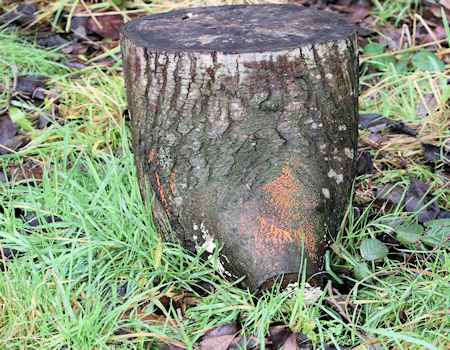
Some may have noticed the orangey spots on some of the logs by the seating area in Raw Nook NR.
The fungi is called Coral Spot and at the moment in is this area there is a excellent display of the fungi with many of the fallen twigs and small branches covered in the fungi.
With the mild weather at the moment I noticed a good number of birds calling or in song at the site
There were at least 3 Robins, a single Coat Tit, Blue and Great Tits and a Mistle Thrush all been confused by the mild temperatures.
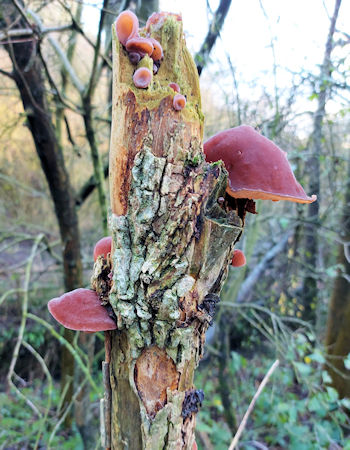
A walk into TH Beck brought me to what I call the Jelly Ear tree!!!. The reason is it has to be the most reliable place to find the very strange Jelly Ear fungi.
To see and have a feel (which is a must!) of this strange fungi head towards the information board at the site and start to walk with the wall on your left as if you are heading towards Dyehouse road. The broken Elder tree with the fungi on it is just on the over side of the wall only a few yards from the information board.
A Tree Creeper and 2 Great spotted Woodpeckers were showing off this morning at Caldene fields. Also seen were 6 Stock Doves and thankfully the 3 Greenfinch are still about taking advantage of the local bird feeders…
Yesterday some may have noticed that workmen were strimming and cutting back shrubs around the bridge at Raw Nook NR which leads onto Toad Holes Beck. Well today I had a conversation with one of the workmen. He told me that the bridge is have it’s 3 year safety survey and that all looks well apart from a re-paint.
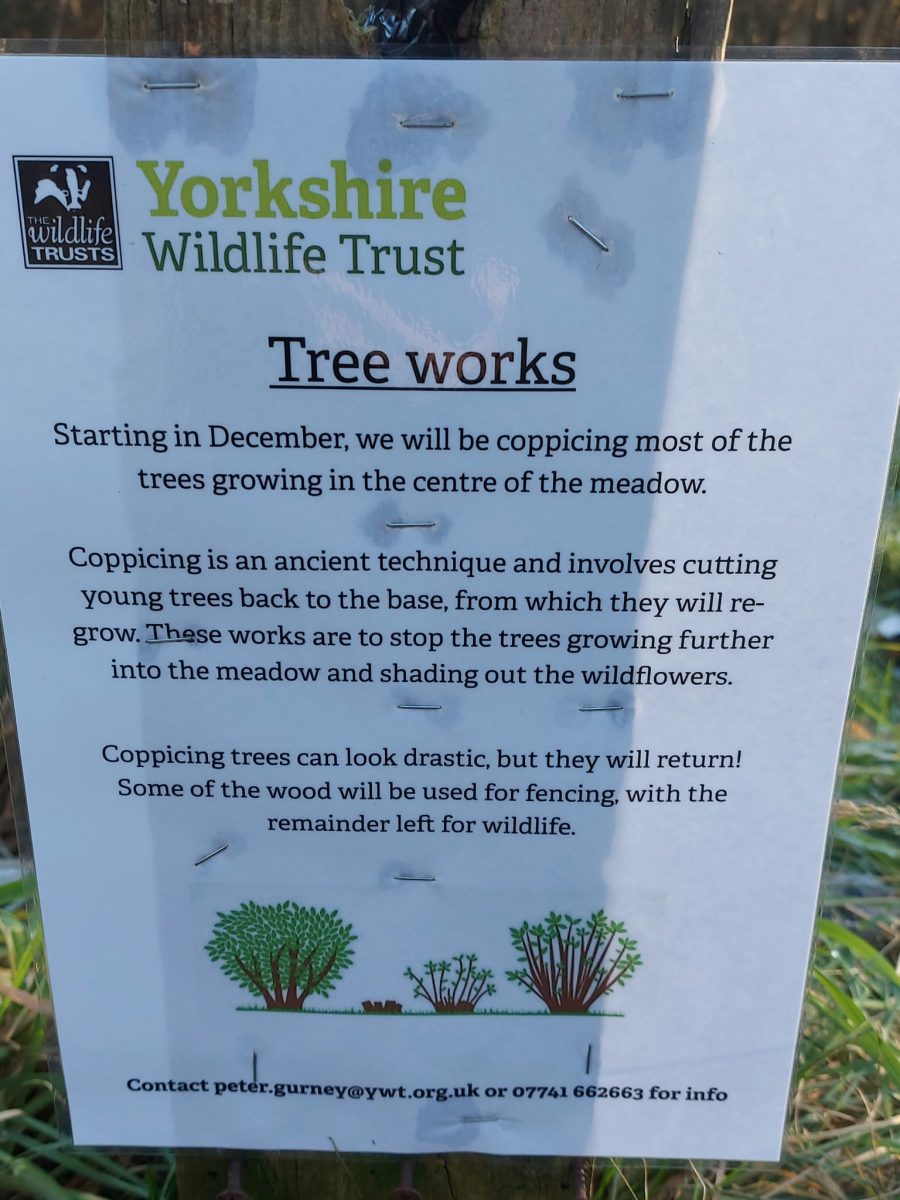
Talking of cutting back shrubs Peter Gurney and his team from the YWT will be coppicing the wooded area in the middle of the meadow.
So if anyone sees people with chainsaws in Raw Nook NR the shrubs and trees are not been cut down but merely coppiced.
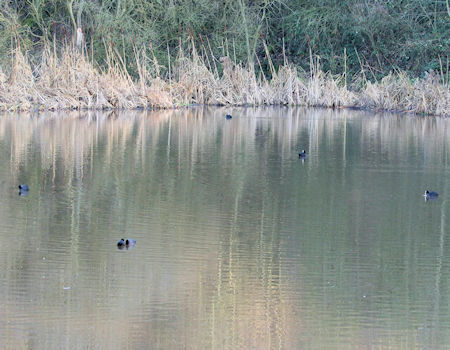
The over-wintering Coots are still doing well at TH Beck with eleven on the large pond this morning. Also showing well at the site were a party of 5 Bullfinches.
Around this time of year I like to find as many species of birds in a single walk around my local patch, which is Raw Nook NR, Caldene fields and Toad Holes Beck.
As I have done this for a number of years it gives an indication of status of species that I know should be found in my local area at this time of the year.
The total is usually between 29-34 species. In years gone by species like the Tree Sparrow could be found but that species has long gone. And believe it or not the Collard Dove was an uncommon species here in the late seventies and now it is every where.
Well the total this year was 32 which is fairly good. Species that were hard to find were as expected the Greenfinch, Kestrel and Moorhen.
I am not too worried about the Moorhen even though I only found one single bird as there are 10 Coot at TH Beck over-wintering and they have probably forced the Moorhens away as they are the dominate species.
On the plus side the Stock Dove is doing very well with up to 6 birds present on a daily basis and the Coat tit appears to be easy to find with birds at CF,s and THB.
I didn’t search for the Tree creepers which is relatively new to our area and has probably bred. The reason for this is it would have disturbed the over-wintering Coots at THB.
Yesterday with snow covering our landscape it was an ideal day to look for the rare (in our area) Jack Snipe a winter visitor to the UK mainly from northern Europe. I have only two records of this wader as it stays hidden, hugging the damp earth, until you virtually tread on it!
Unfortunately I didn’t find one as I searched Raw Nook NR and Toad Holes Beck.
However, I did find two Common Snipe by the frozen pond at Raw Nook NR.
Both flew off towards Toad Holes Beck.
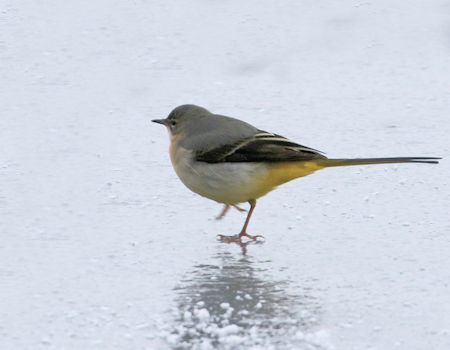
At the later site I found a pair of lovely Grey Wagtails (Opposite) so I wasn’t too disappointed.
Also at TH Beck was a flyover Cormorant which headed to the east.
The surprise was a Ring Necked Parakeet which was calling over Woodlands cricket club.
This bird could stay in our area during the winter. So keep at eye out at your garden feeders especially if you put out peanuts.
There were 9 Coot on the large pond and strangely only one Moorhen. I had a look on the middle pond for a possible winter Water Rail but with no luck but it is perhaps a bit early, they usually appear mid-winter.
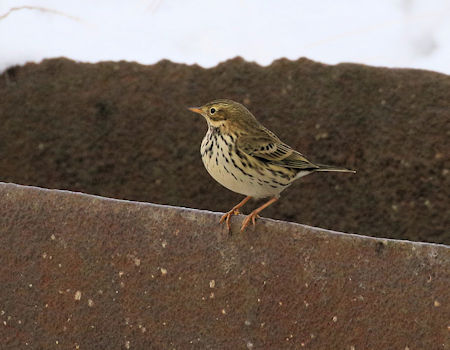
A late Meadow Pipit was also found probably on it’s way south for the winter.
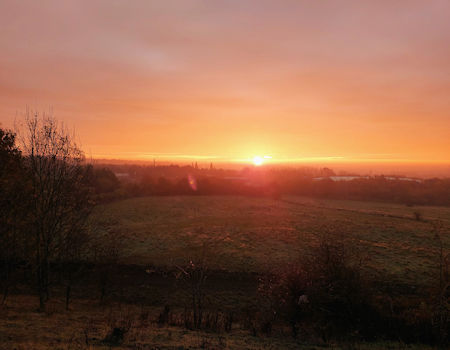
Firstly I have to say what a wonderful sunrise it was this morning from the watch point. Although after sunrise it became very overcast with open skies to the east.
It was from this direction that small amounts of Redwings and continental Starling came in from and moved both to the S/W and N/W.
The real surprise though was my third Peregrine falcon on the autumn. The bird came in low from the S/E over Caldene fields and moved N/W giving very good views.
Also of interest was the first lapwings, (7 in total )of the autumn which moved to the S/W.
As we know Cormorants are increasing in inland areas and this year has been a bumper year for the species with an excellent 72 birds viewed from the watch point since early September to date. Last year I recorded over the same period just 43 birds.
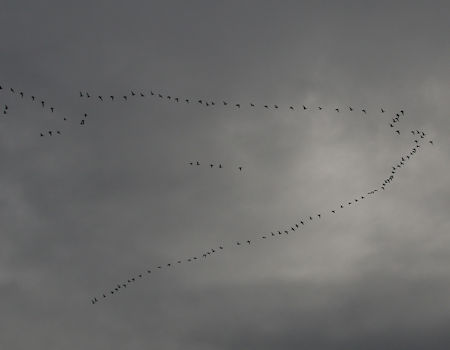
I spoke about how overcast it became…well this is a party of 109 Pink-footed geese which came in from the E and moved S/W
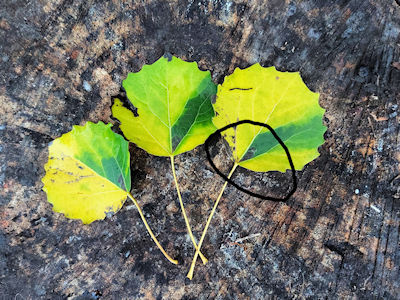
Today I set out to find any Ectoedemia argyropezaa micro moth leaf mines at Raw Nook NR. I have found the species in Aspen leaves at Caldene fields but until today I couldn’t find any at RN.
This common species of micro moth is extremely difficult to identify as an adult moth. However, at this time of year if you can find the leaf mine it is distinctive and you can prove that the species is breeding, which is good for the reserve.
I found at least 11 leaves and there must be many more in the leaf litter.
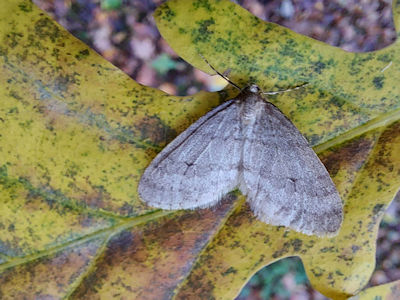
On my way back I spotted a moth resting on an Oak leaf.
I wasn’t sure at first what species it was so I took some photos for research at home.
It was a Northern Winter Moth Operophtera fagata another new species for the reserve which is great news.
This website uses cookies to improve your experience. We'll assume you're ok with this, but you can opt-out if you wish.AcceptRead More
Privacy & Cookies Policy
Privacy Overview
This website uses cookies to improve your experience while you navigate through the website. Out of these, the cookies that are categorized as necessary are stored on your browser as they are essential for the working of basic functionalities of the website. We also use third-party cookies that help us analyze and understand how you use this website. These cookies will be stored in your browser only with your consent. You also have the option to opt-out of these cookies. But opting out of some of these cookies may affect your browsing experience.
Necessary cookies are absolutely essential for the website to function properly. This category only includes cookies that ensures basic functionalities and security features of the website. These cookies do not store any personal information.
Any cookies that may not be particularly necessary for the website to function and is used specifically to collect user personal data via analytics, ads, other embedded contents are termed as non-necessary cookies. It is mandatory to procure user consent prior to running these cookies on your website.