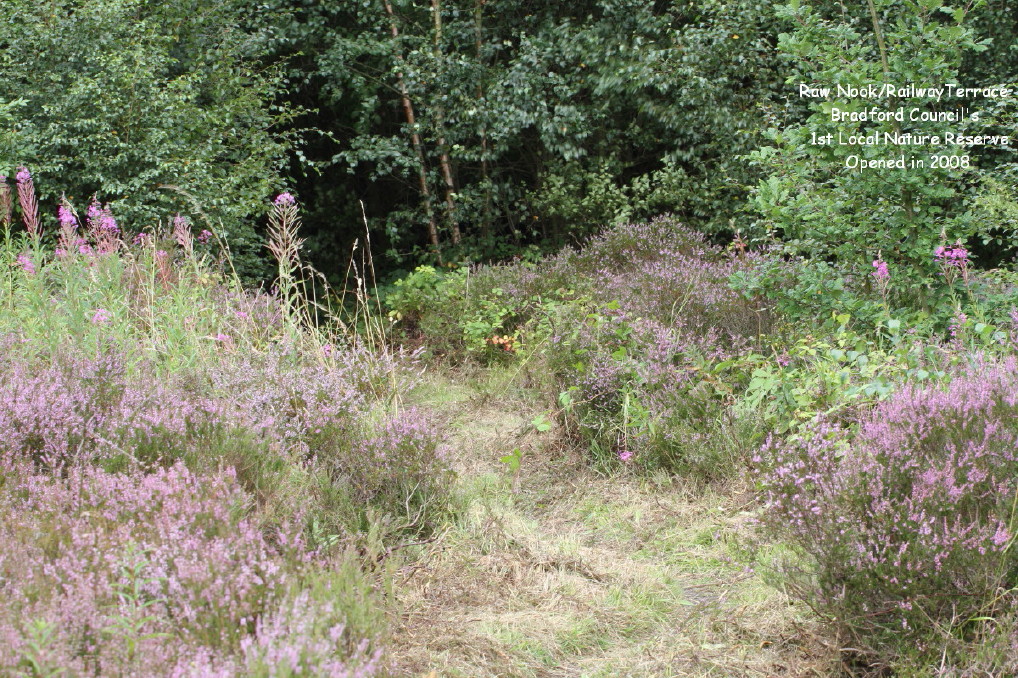
On Saturday our conservation group had our monthly work day at Raw Nook LNR.
You may recall we had earlier cut down some large saplings to enhance the breeding opportunities for ground nesting birds.
So with the cut down wood Richard and Bill set to work to create a dead hedge which would provide nesting habitats for Thrushes, Dunnocks and Wrens etc and top marks as the finished hedge was Brill!
A good number of logs were also created so I thought of a log pile with an additional bee hotel which will be beneficial for not only our Bees but other invertebrates.
So a suitable site has now been found so…Watch this space!
I found a Long Tailed Tit’s nest which we all observed from a distance and Peacock butterfly enjoyed the sunshine.
However, there was some bad news!
Once again we filled two bags with litter and even more sad was the number of Poo Bags which were discarded by irresponsible so called dog owner!
The first spring migrants, Chiffchaffs are back in our area!
On the 19/3 I visited Low Moor Banks and found a single male Chiffchaffs in song. I then went to Toad Holes Beck and found a further 3 birds. Raw Nook LNR also held 2 singing birds with Caldene fields having a probable passage bird on the following day.
We did some tree pruning at Raw Nook LNR on the 21/3 and just as we were finishing I glimpsed a nearby Tree Creeper which was great. But on the next tree was another TC which looked alot cleaner and smarter and I took this bird to possible be the male. Both birds then flew off together which is excellent news.
If they find a nest site it would be a new breeding record for the reserve.
Relating to my last blog ‘ Helping the Warblers’ to find suitable nesting habitat at Raw Nook LNR I have arranged for a retired experienced landscaper to carry out some conservation work at 10 am on Thursday 21/3.
The aim is to reduce some of the Silver Birch mature saplings that are spreading and blocking light to the canopy floor which in turn is reducing nesting opportunities for birds like the Chiffchaff and Willow Warblers limiting any wild flowers to grow.
Mature trees will not be cut only not mature saplings and this will be carried out using a chain saw.
The area will be checked for any early nests and if there is any hint of one found the work will not be carried out.
Over the years I have noticed that ground nesting warblers like the Willow Warblers and Chiffchaffs have been looking at territories in spring at Raw Nook LNR but few have actually bred.
One of the reasons for this is Bramble that has encroached into their favourite nesting areas within the site. So on Saturday it was our groups conservation morning and we all set about clearing the dense Bramble and cutting down some small saplings to let more light into the area. It was hard work! but worth it as we all hoped that when the males arrived back in spring they should find a more suitable nesting habitat.
At the moment Raw Nook LNR is full of the beautiful Scarlet Elf cup fungi. The fungus like damp habitats and with all the recent rain I think the species is having a bumper time!
Interestingly I visited nearby Toad Holes Beck and found only a few mainly by the large pond. The resident Tree Creeper was also observed in the same area.
Also at the site were the winter flock of feeding Siskin (around 40).
PLEASE NOTE: Toad Holes Beck is slightly flooded and the paths are slippy
Following on from my sighting of a Barn Owl in our area on the 22/10/23. There has been another excellent sighting…well in fact a video of a Barn Owl (Thank you Tracey) this time in the Cleckheaton area.
I suspect this is the same bird that I sighted at East Bierely and a member of the public who reported a ‘ Whitish looking owl ‘ at Caldene fields Low Moor in November 23.
In winter a Barn owl will move further for it’s food than it will in the breeding season when food will be more plentiful.
The distance between the Cleckheaton site and Raw Nook LNR is approximately 4 miles as the crow(Owl) flies, which is well in the range of a winter feeding owl.
I remember a few years ago seeing a Common Buzzard in our area which was a site first! and now last year I found a juvenile been fed by an adult which was excellent news.
Fingers crossed the same happens with the Barn Owl and it breeds in the south Bradford area.
I more than welcome any further sightings in our area and the Spen Valley.
There has been odd sightings of a Nuthatch feeding in our area since late last year.
However, there is now some excellent news in that in the first week of January 24 I had not one but two Nuthatches feeding in my garden at Low moor.
The pair stopped for a good 10 minutes feeding on peanuts and suet blocks before leaving together.
This is a garden first for me..and I have only had to wait 40+ years.
Looking at the two birds together I believe they maybe a pair as one bird shows a stronger terracotta colour on it’s flanks (male) whereas the females flanks are slightly lighter.
If this is the case fingers crossed they find a suitable nest site..IN OUR AREA!
The heavy rain and high winds have caused some damage in our area.
A tree has fallen across the footpath leading into Toad Hole Beck when coming from Raw Nook NR.
So please take care on this footpath however, the good news is we have a conservation workday on Saturday so we will remove the tree making the site safe.
Toad holes Beck has flooded but the footpath is passable with care.
Also the footpath from Caldene fields is flooded so wellies are in order. Thankfully the water has not reached the main footpath which is fine.
Today at Toad Holes Beck I heard the call of a Nuthatch. This is the third report now of the rare species to our area. The first brief view was of a bird in my garden during August.
The bird must be feeding well and liking the habitat in our area lets hope like the recent arrival of the Tree Creeper that now breeds in Toad Holes Beck the Nuthatch finds a mate and well…let’s nature take it course!
Any sightings of our guest in our area please let me know, Thank you.
A fungi walk was arranged with the Bradford Environmental Education Service for the 24th of October at Raw Nook NR and there was a common theme…IT WAS RAINING!
But we were not deterred and while I showed the group around the site it was down to John Gavaghan who is certainly more knowledgeable on fungi than I am.
We started in the meadow area with not that much found. However, I manage to show them the lovely Saffron milk cap which found previously by YWT by a small number of Scots Pines. John gave some valuable tips to the group about firstly identifying the species of trees/habitat and then asking the question does it match with the habitat of your species ?
One of the group found a great example of the very common The Candlesnuff fungus.
What is slightly unusual here is you never really get a good view of the black base of this fungi whereas with this find you do.
Despite the rain John identified more and more species like The Fiery Milkcap which lived up to it’s name!, Blushing Bracket, Hairy Curtain Crust, Snowy Waxcaps lots of Sulphur Tuft, Brown Birch Bolete, an emerging Blusher, Deceivers, Fly Agarics (they like birch woodland), Pipe Clubs, and Lilac Bonnet.
As we walked along the path I had a trick up my sleeve. Earlier in the month YWT had found a stained turquoise coloured twig of the Green Elf cup fungus and I kept it to show the BEEs group, sadly though we didn’t find the actual fruiting body.
Scarlet Caterpillarclub
I knew an area by the pond which has the aptly named Ugly Milkcap. Whilst looking for this species I saw a small orange fungi sticking out of the ground. I had a good idea that it was the Scarlet Caterpillar club fungus but thankfully John confirmed the sighting.
We all managed to get photo’s and we discussed all about the species which is a parasitic fungus that grows on the larvae and pupae of moths.
By now had reached the pond but there was one more surprise a A sulphur knight was confirmed by the Oak tree.
We had not had any dinner we were soaked and reached the half away point of the reserve and sadly the decision was taken to call it a day.
However, we had found a respectable 29 different species (with a couple still not ID ) and one new species for the reserve Hairy Curtain Crust – Stereum hirsutum.
I would like to thank John for his ID skills and the rest of the group for making the walk, despite the weather a really enjoyable day.
This website uses cookies to improve your experience. We'll assume you're ok with this, but you can opt-out if you wish.AcceptRead More
Privacy & Cookies Policy
Privacy Overview
This website uses cookies to improve your experience while you navigate through the website. Out of these, the cookies that are categorized as necessary are stored on your browser as they are essential for the working of basic functionalities of the website. We also use third-party cookies that help us analyze and understand how you use this website. These cookies will be stored in your browser only with your consent. You also have the option to opt-out of these cookies. But opting out of some of these cookies may affect your browsing experience.
Necessary cookies are absolutely essential for the website to function properly. This category only includes cookies that ensures basic functionalities and security features of the website. These cookies do not store any personal information.
Any cookies that may not be particularly necessary for the website to function and is used specifically to collect user personal data via analytics, ads, other embedded contents are termed as non-necessary cookies. It is mandatory to procure user consent prior to running these cookies on your website.